AI Strategy · Event Notes
Building Got Cheap. Knowing What to Build Didn't.
I spent a day at the first LATAM AI Summit in San Francisco listening to investors and founders building across the Americas. Nobody on stage debated tooling. Everyone arrived at the same uncomfortable truth from different directions.
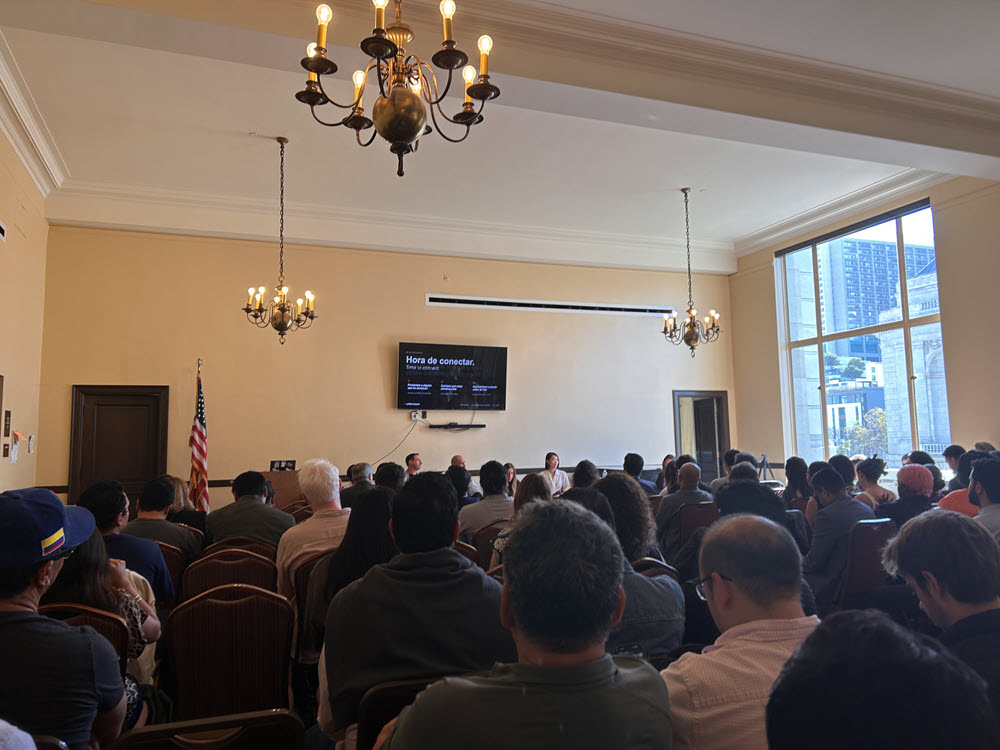
This week, seven Latin American consulates in San Francisco—including Brazil, Chile, Colombia, Mexico, Peru, and Uruguay—brought together founders, venture capital investors, and diplomats in the same room for the inaugural LATAM AI Summit. I went to listen for one thing: what the people actually writing checks and shipping products truly believe today, stripped of onstage cheerleading.
I went in expecting model benchmarks and agent demos. What I found instead was a room full of people saying, across different accents and from opposite sides of the table, that the hard part of AI has moved. And it moved directly into an area where most small business owners aren't looking.
Building Is No Longer the Bottleneck
Paolo Privitera, a serial entrepreneur whose events company Evensi was acquired by Events.com, shared that over the past two months he rebuilt four paid tools he used—each costing around $50 a month—in just a few minutes of work using an AI assistant. He didn't do it to save $200. He did it because he wanted them custom-tailored to his workflow, and now he could.
Luisa Dalla Costa, a partner at Latitud—the São Paulo fund that writes first checks to Latin American founders—echoed the exact same point from the investor side. Technology used to be the barrier to entry. If you were the only one who knew how to build a complex system, you won. That barrier has vanished. The entire weight has now shifted to what you build and why.
Founders on the product-market fit panel put it even more bluntly. In the past, you validated an idea with mockups because a working prototype was expensive. Today you can build a working product overnight. The methods have evolved; the fundamentals haven't: talking to users, uncovering the genuine pain point, and figuring out whether anyone will actually pay.
What is scarce is no longer the ability to build. It is knowing which problem is worth solving.
One founder admitted he has lost count of how many times his team pivoted before landing on a problem truly worth solving. That is the exact part AI does not shorten.
A Feature Is Not a Business
Privitera drew the sharpest distinction of the day. A feature is easy to copy—today it gets copied in an afternoon. A business possesses something hard to replicate: proprietary data, user habits, and relationships cultivated over years. His example was event search. Anyone can ask an AI for a list of events in San Francisco. What an AI cannot manufacture is knowing who actually showed up, who checked in at the door, and who returned.
For a small business, this is tremendous news when read correctly. Your competitive advantage was never your software. It is the twelve years spent knowing how your clients order, which supplier falls behind every December, and what quality craftsmanship looks like in your trade. That domain knowledge is your moat. Software that captures it multiplies it. Software that ignores it is a toy.
The Messy Process Is the Asset
Dalla Costa pointed to sectors where AI tech giants will struggle to make inroads: heavily regulated industries with deep, specialized workflows—such as fintech, healthcare, insurance, and legal—where you must know exactly how the work gets done, how it sells, and what compliance demands. In those domains, the operator who knows the ground wins, because generic tools cannot see the nuance.
María Gracia Lagos from Copec WIND Ventures—the San Francisco corporate venture capital arm of Chilean energy and retail conglomerate Empresas Copec—added the indispensable prerequisite: pinpointing those specific workflows and organizing the underlying data first. Data hygiene before AI. In her world, that means mining and industrial operations. In yours, it might be the spreadsheet that three people edit simultaneously and nobody fully trusts.
It's the very same lesson I encounter every month with clients. A process that only you understand is valuable. A process that only you understand and that nobody ever documented becomes an operational crisis the moment you try to automate it.
A Government Said It Out Loud
During opening remarks, Mexico's consular delegation presented the Chapultepec Principles, an AI ethical framework released in January by Mexico's Ministry of Science (Secihti) and the Digital Transformation and Telecommunications Agency. Two of the ten principles deserve a spot on every business owner's wall:
- If a decision cannot be explained, it should not be automated.
- Before automating, you must thoroughly understand who and what it impacts.
They drafted them for public policy. They apply just as well to your billing pipeline. If you can't sketch the workflow on a napkin and explain why each step exists, AI won't fix it. It will merely run the broken version faster.
Price for Outcomes, and Move Fast
Franklin Marcelo, founder of Flexi—which builds AI agents that sell and handle customer service over WhatsApp—described their company's pricing shift: charging a percentage of measurable improvements after the client experiences them, not before. He noted this works especially well across Latin America, where buyers are price-sensitive and skeptical of paying for unproven promises.
And speed surfaced in every panel. Privitera said that when he messages a founder, he expects a meaningful answer in minutes, even in the middle of the night, because basic inquiries should already be handled by an AI assistant. Lagos highlighted the same expectation for teams: prove you can execute and pivot rapidly, because the landscape changes every week. Velocity has become the litmus test for whether AI is genuinely woven into your operational fabric, or just sitting in an open browser tab.
Key Takeaways
I walked away with five rules I now share with every client asking where to begin:
Stop shopping for tools first
The tooling is already the cheap part. Spend your first hour explicitly defining the problem that drains the most time or money each week.
Map the process before you automate it
If you can't explain it simply, don't automate it. The napkin test is free and eliminates most bad projects before they even start.
Clean up the data you already own
Your records, your transaction history, and your customer patterns are what competitors cannot clone. Without clean data, that advantage turns into noise.
Charge for outcomes only if you can measure them
Outcome-based pricing is honest and compelling, but only if you have an established baseline. Without a "before" metric, there is no outcome to bill for.
Make speed felt by your customers
Deploy AI where clients feel the impact: faster quotes, quicker resolutions, and proactive follow-ups. That is the clearest proof the work is real.
I am not saying building doesn't matter—quite the opposite. I share what Dalla Costa noted: good engineers remain good engineers, and an inexpensive prototype still needs someone who understands what production-grade systems look like. The revenue and user figures speakers mentioned regarding their own companies belong to them, and I have omitted any I could not independently verify.
Find the One Problem Worth Automating
Our Machine Mirror audit maps how your business actually operates, uncovers the process that costs you the most, and gives you an honest assessment of whether AI will improve it or whether the workflow needs fixing first.
Work With UsWant insights like this delivered to your inbox? Subscribe here.
Sources
- LATAM AI Summit, San Francisco, October 8, 2026: Opening remarks; "Building AI Startups Across Regions" panel; Product-market fit panel. Author's live notes and session transcriptions.
- Secihti and Digital Transformation & Telecommunications Agency (Mexico), "Chapultepec Principles: Declaration of ethics and best practices for the use and development of Artificial Intelligence", January 29, 2026. secihti.mx
- Brazil Journal, "De go local a go global: a AI está ampliando a ambição das startups" (Latitud, Luisa Dalla Costa). braziljournal.com
- TechCrunch, "Wind Ventures gears up to invest in startups looking at Latin America", June 18, 2020 (Copec WIND Ventures). techcrunch.com
- Startups.com.br, "Nascida no Vale do Silício, Flexi busca seed para crescer no Brasil" (Franklin Marcelo, Flexi), June 2023. startups.com.br
- Startup Grind Veneto, speaker profile for Paolo Privitera (Evensi, acquired by Events.com in 2020). startupgrind.com